Modern Dissent from the Creeds
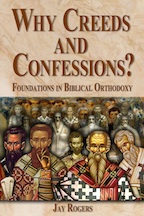
Driving down a country road sometime, you might see a fundamentalist church with a sign proudly proclaiming: “No book but the Bible — No creed but Christ.” The problem with this statement is that the word creed (from the Latin: credo) simply means “belief.” All Christians have beliefs, regardless of whether they are written. The creeds of the early Church were nothing more than scriptural statements of faith put into a systematic format.
The emphasis on creeds and confessions suffered a blow at the end of the last century, when conservative evangelicals reacted against Protestant denominations which fell into liberalism. “Dead orthodoxy” became a term to describe churches that officially held to the creeds and a confession of faith, yet had little fruit to testify to the genuine salvation of their members. To vanquish this apostasy, the evangelical movement (and the fundamentalists a few years later) emerged emphasizing salvation as an individual experience and the “literal” interpretation of Scripture.
The evangelical and fundamentalist movements were bulwarks against liberal apostasy. They did away with most of the public reading of Scripture, creeds and confessions. Liturgical services were abandoned in favor of a less formal, “seeker-friendly” type of evangelical meeting. There is certainly nothing wrong with this. But in abandoning the liturgy, they forgot to teach new church members the core elements of the faith found in the creeds and confessions. De-emphasizing the public reading of creeds was intentionally good, but it had disastrous consequences.
Among Pentecostals and charismatics — two of the most recent groups to have come out of the evangelical and fundamentalist movements — we see an even greater emphasis on throwing off formalism and dead orthodoxy in favor of freedom of worship and spiritual experience. Yet we most often find heresies among churches that stress experience over doctrine. This is not to say that Christians must now throw off their experience and freedom in order to return to dead liturgical services. Simply, what is needed at this time is a revival of confessional orthodoxy.
We call this movement — “confessionalism” — which is nothing more than the historic faith of the Early Church Fathers, Augustine, Luther, Calvin and the Puritans. Through even a casual study of the creeds and confessions, you will find that confessionalism stands in stark contrast to what is being offered today by evangelical Christianity.
Today, we have more options than ever before for becoming heretics. Modern evangelical leaders make all sorts of wild claims and assert teachings which are not orthodox. The 20th century Church has promoted many doctrines which are not historically orthodox. Pelagianism, Sabellianism, modalism, antinomianism and Gnosticism are frequent heresies. Yet I do not believe that most modern evangelicals intentionally hold to heresies. I believe that some have propagated these ideas due to their ignorance or carelessness in what they have written and preached. Today, we all need a greater knowledge of confessional orthodoxy.
I offer the following recovery plan to all evangelicals who wish to build a comprehensive systematic theology based on biblical orthodoxy:
First, avoid the trash that is churned out by the modern evangelical pulp mills! Once this faulty paradigm is demolished, you should begin to build a new foundation for your faith by studying the creeds of the early Church. Then graduate to the more exhaustive and theologically comprehensive confessions of the Reformation period. (I have included a list of these confessions at the end of chapter six for further study.)
You should then read some select writings of Augustine, Luther, Calvin, Knox, and the Puritans. With an understanding of confessional orthodoxy, you will see more clearly that these giants of the faith were theologically grounded in the creeds and confessions. Then read some of the sermons and writings of great modern Christian leaders such as George Whitefield, Jonathan Edwards, John Wesley, Charles Haddon Spurgeon and Charles Hodge.
I hope that by the study of these timeless, immutable truths, you will strengthen your resolve to press into God in prayer and study of Scripture in order to know Jesus Christ in a fuller, more intimate way.
*The Apostles’ Creed with Notes and Explanations**
A creed generally emphasizes the beliefs opposing those errors that the compilers of the creed think most dangerous at the time. The Creed of the Council of Trent, which was drawn up by the Roman Catholics in the 1500s, emphasized those beliefs that Roman Catholics and Protestants were arguing about most furiously at the time. The Nicene Creed, drawn up in the fourth century, is emphatic in affirming the Deity of Christ, since it is directed against the Arians, who denied that Christ was fully God. The Apostles’ Creed, drawn up in the first or second century, emphasizes the true humanity, including the material body, of Jesus, since that is the point that the heretics of the time (Gnostics, Marcionites, and later Manicheans) denied. (See 1 John 4:1-3)
Thus the Apostles’ Creed is as follows:
- I believe in God the Father Almighty,
- Maker of Heaven and Earth,
The Gnostics held that the physical universe is evil and that God did not make it.
- And in Jesus Christ, His only Son, Our Lord,
- Who was conceived by the Holy Ghost,
- Born of the Virgin Mary,
The Gnostics were agreed that the orthodox Christians were wrong in supposing that God had taken human nature or a human body. Some of them distinguished between Christ, whom they acknowledged to be in some sense divine, and the man Jesus, who was at most an instrument through whom the Christ spoke. They held that the man Jesus did not become the bearer or instrument of the Christ until the Spirit descended upon him at his baptism, and that the Spirit left him before the crucifixion, so that the Spirit had only a brief and tenuous association with matter and humanity. Others affirmed that there was never a man Jesus at all, but only the appearance of a man, through which appearance wise teachings were given to the first disciples. Against this the orthodox Christians affirmed that Jesus was conceived through the action of the Holy Spirit (thus denying the Gnostic position that the Spirit had nothing to do with Jesus until his Baptism), that He was born (which meant that he had a real physical body, and not just an appearance) of a virgin (which implied that he had been special from the first moment of his life, and not just from the baptism on.
- Suffered under Pontius Pilate,
There were many stories then current about gods who died and were resurrected, but they were offered quite frankly as myths, as non-historical stories symbolic of the renewal of the vegetation every spring after the seeming death of winter. If you asked, “When did Adonis die?” you would be told either, “Long ago and far away,” or else, “His death is not an event in earthly time.” Jesus, on the other hand, died at a particular time and place in history, under the jurisdiction of Pontius Pilate, Procurator of Judea from 26 to 36 A.D., during the last ten years of the reign of the Emperor Tiberius.
- was crucified, dead, and buried; he descended into Hades.
Here the creed hammers home the point that He was really dead. He was not an illusion. He was nailed to a cross. He died. He had a real body, a corpse, that was placed in a tomb. He was not merely unconscious — His spirit left his body and went to the realm of the dead. It is a common belief among Christians that on this occasion He took the souls of those who had died trusting in the promises made under the Old Covenant — Abraham, Moses, David, Elijah, Isaiah, and many others — and brought them out of the realm of the dead and into heavenly glory. But the creed is not concerned with this point. The reference to the descent into Hades (or Hell, or Sheol) is here to make it clear that the death of Jesus was not just a swoon or a coma, but death in every sense of the word.
- The third day he rose from the dead, he ascended into heaven,
- and is seated at the right hand of God the Father Almighty.
- From thence he shall come to judge the living and the dead.
- I believe in the Holy Ghost,
- the holy catholic church,
The Gnostics believed that the most important Christian doctrines were reserved for a select few. The orthodox belief was that the fullness of the Gospel was to be preached to the entire human race. Hence the term “catholic,” or universal, which distinguished them from the Gnostics.
- the communion of saints,
- the forgiveness of sins,
The Gnostics considered that what men needed was not forgiveness, but enlightenment. Ignorance, not sin, was the problem. Some of them, believing the body to be a snare and delusion, led lives of great asceticism. Others, believing the body to be quite separate from the soul, held that it did not matter what the body did, since it was completely foul anyway, and its actions had no effect on the soul. They accordingly led lives that were not ascetic at all. Either way, the notion of forgiveness was alien to them.
- the resurrection of the body,
The chief goal of the Gnostics was to become free forever from the taint of matter and the shackles of the body, and to return to the heavenly realm as Pure Spirit. They totally rejected any idea of the resurrection of the body.
- and the life everlasting. AMEN
The Nicene Creed
The Nicene Creed is the most widely accepted and used brief statements of the Christian Faith. In liturgical churches, it is said every Sunday as part of the Liturgy. It is common ground to Eastern Orthodox, Roman Catholics, Anglicans, Lutherans, Calvinists, and many other Christian groups. Many groups that do not have a tradition of using it in their services nevertheless are committed to the doctrines it teaches.
Someone may ask, “What about the Apostles’ Creed?” Traditionally, in the West, the Apostles’ Creed is used at Baptisms, and the Nicene Creed at the Eucharist (the Lord’s Supper, or the Holy Communion). The East uses only the Nicene Creed.
The following is the text of the Nicene Creed followed by notes and explanations.
I believe in one God,
the Father, the Almighty,
maker of heaven and earth,
of all that is, seen and unseen.
I believe in one Lord, Jesus Christ,
the only son of God,
eternally begotten of the Father,
God from God, Light from Light,
true God from true God,
begotten, not made,
of one being with the Father.
Through him all things were made.
For us and for our salvation
he came down from heaven:
by the power of the Holy Spirit
he became incarnate from the Virgin Mary,
and was made man.
For our sake he was crucified under Pontius Pilate;
he suffered death and was buried.
On the third day he rose again
in accordance with the Scriptures;
he ascended into heaven
and is seated at the right hand of the Father.
He will come again in glory
to judge the living and the dead,
and his kingdom will have no end.
I believe in the Holy Spirit, the Lord, the giver of life,
who proceeds from the Father [and the Son].
With the Father and the Son
he is worshipped and glorified.
He has spoken through the Prophets.
I believe in one holy catholic and apostolic Church.
I acknowledge one baptism for the forgiveness of sins.
I look for the resurrection of the dead,
and the life of the world to come. AMEN.
*Notes and Explanations**
When the Apostles’ Creed was drawn up, the chief enemy was Gnosticism, which denied that Jesus was truly Man; and the emphases of the Apostles’ Creed reflect a concern with repudiating this error.
When the Nicene Creed was drawn up, the chief enemy was Arianism, which denied that Jesus was fully God. Arius was a presbyter (an elder) in Alexandria in Egypt, in the early 300’s. He taught that the Father, in the beginning, created (or begot) the Son, and that the Son, in conjunction with the Father, then proceeded to create the world. The result of this was to make the Son a created being, and hence not God in any meaningful sense. It was also suspiciously like the theories of those Gnostics and pagans who held that God was too perfect to create something like a material world, and so introduced one or more intermediate beings between God and the world. God created A, who created B, who created C, … who created Z, who created the world. Alexander, Bishop of Alexandria, sent for Arius and questioned him. Arius stuck to his position, and was finally excommunicated by a council of Egyptian bishops. He went to Nicomedia in Asia, where he wrote letters defending his position to various bishops. Finally, the Emperor Constantine summoned a council of Bishops in Nicea (across the straits from modern Istanbul), and there in 325 the Bishops of the Church, by a decided majority, repudiated Arius and produced the first draft of what is now called the Nicene Creed. A chief spokesman for the full deity of Christ was Athanasius, deacon of Alexandria, assistant (and later successor) to the aging Alexander. The Arian position has been revived in our own day by the Watchtower Society (Jehovah Witnesses), who explicitly hail Arius as a great witness to the truth.
Here is the Nicene Creed a second time, with notes inserted.
- I believe in one God,
- the Father, the Almighty,
- maker of heaven and earth,
- of all that is, seen and unseen.
- I believe in one Lord, Jesus Christ,
- the only son of God,
Here and elsewhere (such as John 1:14) where the Greek has MONOGENETOS HUIOS, an English translation may read either “only Son” or “only begotten Son.” The Greek is ambiguous. The root GEN is found in words like “genetics, generation,” and suggests begetting. However, it is also found in words like “genus” and suggests family or sort or kind. Accordingly, we may take MONOGENETOS to mean either “only begotten” or “one-of-a-kind, only, sole, unique.”
- eternally begotten of the Father,
One might suppose that this means that the Son was begotten, “before the galaxies were formed,” or something like that. But in fact it means something a little different. Arius was fond of saying, “The Logos is not eternal. God begat him, and before he was begotten, he did not exist.” Athanasius replied that the begetting of the Logos was not an event in time, but an eternal relationship.
- God from God, Light from Light,
A favorite analogy of the Athanasians was the following: Light is continously streaming forth from the sun. (In those days, it was generally assumed that light was instantaneous, so that there was no delay at all between the time that a ray of light left the sun and the time it struck the earth.) The rays of light are derived from the sun, and not vice versa. But it is not the case that first the sun existed and afterwards the Light. It is possible to imagine that the sun has always existed, and always emitted light. The Light, then, is derived from the sun, but the Light and the sun exist simultaneously throughout eternity. They are co-eternal. Just so, the Son exists because the Father exists, but there was never a time before the Father produced the Son. The analogy is further appropriate because we can know the sun only through the rays of light that it emits. To see the sunlight is to see the sun. Just so, Jesus says, “He who has seen me has seen the Father” (John 14:9).
- true God from true God,
- begotten, not made,
This line was inserted by way of repudiating Arius’ teaching that the Son was the first thing that the Father created, and that to say that the Father begets the Son is simply another way of saying that the Father has created the Son.
Arius said that if the Father has begotten the Son, then the Son must be inferior to the Father, as a prince is inferior to a king. Athanasius replied that a son is precisely the same sort of being as his father, and that the only son of a king is destined himself to be a king. It is true that an earthly son is younger than his father, and that there is a time when he is not yet what he will be. But God is not in time. Time, like distance, is a relation between physical events, and has meaning only in the context of the physical universe. When we say that the Son is begotten of the Father, we do not refer to an event in the remote past, but to an eternal and timeless relation between the Persons of the Godhead. Thus, while we say of an earthly prince that he may some day hope to become what his father is now, we say of God the Son that He is eternally what God the Father is eternally.
- of one being with the Father.
This line: “of one essence with the Father, of one substance with the Father, consubstantial with the Father,” was the crucial one, the acid test. It was the one formula that the Arians could not interpret as meaning what they believed. Without it, they would have continued to teach that the Son is good, and glorious, and holy, and a Mighty Power, and God’s chief agent in creating the world, and the means by which God chiefly reveals Himself to us, and therefore deserving in some sense to be called divine. But they would have continued to deny that the Son was God in the same sense in which the Father is God. And they would have pointed out that, since the Council of Nicea had not issued any declaration that they could not accept, it followed that there was room for their position inside the tent of Christian doctrine, as that tent had been defined at Nicea. Arius and his immediate followers would have denied that they were reducing the Son to the position of a high-ranking angel. But their doctrine left no safeguard against it, and if they had triumphed at Nicea, even in the negative sense of having their position acknowledged as a permissible one within the limits of Christian orthodoxy, the damage to the Christian witness to Christ as God made flesh would have been irreparable.
Incidentally, HOMOOUSIOS (“one being”) is generally written without the hyphen. The word has five syllables HO-mo-OU-si-os, with accents on first and third, as shown. The Greek root HOMO, meaning “same,” is found in words like “homosexual” and “homogenized,” and is not to be confused with the Latin word HOMO, meaning “man, human.”
The language finally adopted in the East was that the Trinity consists of three HYPOSTASES (singular HYPOSTASIS) united in one OUSIA. The formula used in the West, and going back at least to Tertullian (who wrote around 200, and whose writings are the oldest surviving Christian treatises written in Latin), is that the Trinity consists of three PERSONAE (singular PERSONA) united in one SUBSTANTIA. In English, we say “Three Persons in one Substance.” Unfortunately, the Greek HYPO-STASIS and the Latin SUB-STANTIA each consists of an element meaning “under, below” (as in “hypodermic,” “hypothermia,” etc.) followed by an element meaning “stand.” Thus it was natural for a Greek-speaker, reading a Latin document that referred to one SUBSTANTIA to substitute mentally a reference to one HYPOSTASIS, and to be very uncomfortable, while a Latin-speaker would have the same problem in reverse. Thus the seeds were sown for a breakdown of communication.
- Through him all things were made.
This is a direct quote from John 1:3. Before the insertion of the HOMO-OUSIOS clause, this line immediately followed “begotten, not made.” The two lines go naturally together. The Son is not a created thing. Rather, He is the agent through Whom all created things come to be.
- For us and for our salvation
- he came down from heaven:
- by the power of the Holy Spirit
- he became incarnate from the Virgin Mary,
- and was made man.
- For our sake he was crucified under Pontius Pilate;
- he suffered and was buried.
By the time of Nicea, it was no longer necessary to emphasize, to spell out unmistakably, that Christ had really died at Calvary, as it had been spelled out in the Apostles’ Creed: “he suffered death and was buried.” Apparently the Nicene Fathers were supposed that their language would not be misunderstood.
- On the third day he rose again
- in accordance with the Scriptures;
The Scriptures referred to here are the Old Testament prophecies concerning Christ. The wording here is borrowed from 1 Corinthians 15:3,4: “And I delivered to you first of all that which I also received: that Christ died for our sins according to the Scriptures, and that he was buried, and that He rose again on the third day according to the Scriptures.”
- he ascended into heaven
- and is seated at the right hand of the Father.
- He will come again in glory to judge the living and the dead,
- and his kingdom will have no end.
- I believe in the Holy Spirit, the Lord, the giver of life,
- who proceeds from the Father [and the Son].
The words shown in brackets, “and from the Son,” are a Western addition to the Creed as it was originally agreed on by a Council representing the whole Church, East and West. They correspond to the Latin word FILIOQUE (FILI = Son, -O = from, -QUE = and; pronounced with accent on the O), and the controversy about them is accordingly known as the Filioque controversy.
If we are looking for a statement that can be taken as common ground by all Christians, East and West alike, it clearly cannot include the FILIOQUE. On the other hand, Western Christians will be unwilling to have it supposed that they are repudiating the statement that the Spirit proceeds jointly from Father and Son.
- With the Father and the Son he is worshipped and glorified.
- He has spoken through the Prophets.
This line was directed against the view that the Holy Spirit did not exist, or was not active, before Pentecost.
- I believe in one holy catholic and apostolic Church.
Many Christians from various backgrounds will want to know, “Precisely what would I be agreeing to if I signed this?” We already defined catholic as “universal.” Catholicity means literally “universality.” All true believers are part of the catholic Church, because they hold to the universal faith.
- I acknowledge one baptism for the forgiveness of sins.
- I look for the resurrection of the dead,
- and the life of the world to come. AMEN.